The First Resilient America Summit

Embedding Resilience Into Public Finance
 

Key Takeaways

  • Resilience has to become part of how governments make financial decisions.

  • The resilience financing model is changing.

  • Resilience is a team sport—but government is at the center of the field.


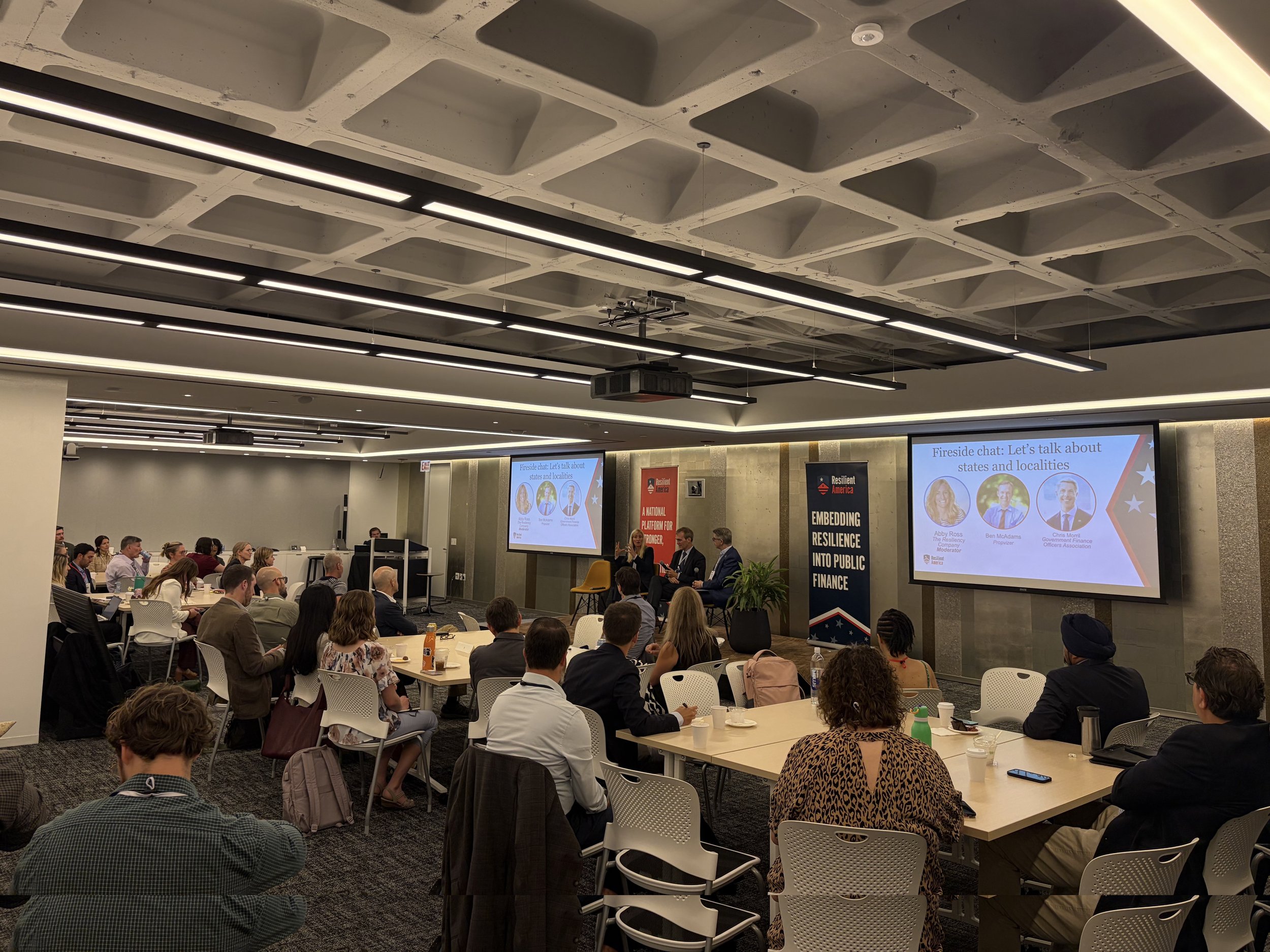
On July 23, Resilient America brought together nearly 100 leaders from state and local government, public finance, insurance, philanthropy, infrastructure, investment, and the broader resilience ecosystem to explore a fundamental question: What will it take to move resilience from a recognized need to something communities can actually finance and deliver at scale?

Public-sector leaders brought real problems to the table. Practitioners and capital providers brought different tools and perspectives. Rather than producing a single answer, the discussions surfaced a consistent set of themes about where the resilience field needs to go next. Here are three:

1. Resilience has to become part of how governments make financial decisions.

Physical risk ultimately becomes fiscal risk—through damaged infrastructure, disrupted revenues, higher operating costs, insurance pressures, and repeated recovery spending. Yet these risks are still too often treated as resilience issues rather than financial ones.

A major theme of the Summit was the need to move resilience out of a silo and into the financial systems governments already use to manage risk and allocate capital. Matt Posner and Shayne Kavanagh of GFOA demonstrated how the RiskReserve Tool (RRT) uses Monte Carlo simulation to translate a range of future risks, including natural hazards, into potential financial losses and test those losses against a government’s reserves. This reframes reserves as a form of self-insurance rather than simply a savings account: Are reserves sufficient for the risks a government faces? Are they excessive? And could some of that capital be better deployed to reduce the underlying risk?

For some communities, that analysis has identified reserve capacity beyond what modeled risks require, opening a conversation about whether capital could be redirected toward risk reduction. The larger opportunity is to make resilience part of ordinary public finance—where physical risk is quantified in financial terms and considered alongside the other risks governments already manage, rather than treated as a separate priority competing for scarce resources.

2. The resilience financing model is changing.

Federal, state and philanthropic grants will remain important, but communities cannot build long-term resilience strategies around grant availability alone. With federal resources less predictable and a potential 50% reduction in federal dollars to states and localities under the current administration the conversation is shifting toward public finance, insurance, private capital, and other market-oriented approaches. 

North Carolina's insurer of last resort demonstrated what's possible: a $50M fortified roof program returned $67M+ in reinsurance savings and avoided losses, and an Insurance-Linked Security (ILS) resilience bond with a resilience kicker targeted $350M but closed at $600M at lower-than-expected cost. The challenge is building a clearer financial case for resilience and creating structures, such as revolving loan funds, resilience bonds, and parametric insurance, that allow different sources of capital to participate at scale.

  • Progress requires coordination. The math on resilience favors action,avoided losses, lower reinsurance costs, stronger credit ratings, but no single actor has the authority to move the whole system. As Xavier De Souza Briggs and I wrote in a recent Epicenter article, progress requires trust and a shared view of the problem across government, utilities, insurers, and private capital. 

  • The tools already exist—the gap is scale. Resilience bonds, PACE financing, parametric insurance, and state revolving loan funds are all proven. But the muni bond market moves $500B/year in infrastructure capital and remains largely untapped by the resilience community. This is the —identified as low-hanging fruit. Nature-based solutions generate $6–$13 in savings per $1 invested, but the investor rarely captures that return directly—a structural policy misalignment that financing innovation alone cannot fix.

  • Nonprofit and public delivery models are essential.  Private capital’s return requirements compete directly with dollars that could otherwise go to projects. The Resilience Authority of Annapolis—the first multi-jurisdictional resilience authority in the country—shows what that difference looks like in practice: independent of government procurement rules, $0.94 of every dollar goes directly to projects, with the ability to blend philanthropic, federal, and private capital in a single transaction.

3. Resilience is a team sport—but the government is at the center.

No single institution can solve community risk alone. The Summit's core diagnosis was that resilience is a coordination problem, not a cost-benefit problem. No single actor has authority to move the whole system. 

Governments, public finance professionals, insurers, investors, philanthropy, nonprofits, developers, engineers, and other partners each bring different tools to the table—as Escondido showed by partnering with a developer and IBHS to create Dixon Trail, the country's first certified wildfire-prepared neighborhood, which cut insurance costs from a projected $8–10K/year to $1,200/year. 

State and local governments are uniquely positioned to convene that ecosystem because they own assets, set policy, allocate capital, and ultimately bear many of the consequences when risks materialize. 

Where We Go From Here

The clearest takeaway from the Summit was that resilience needs both a common financial starting point and a team around the table.

We need to move beyond asking simply, How do we fund this project? and start asking, What financial risk does this community face, what outcomes could change that trajectory, and how should we invest accordingly? The RiskReserve Tool (RRT) provides a starting point: a common dataset that translates a community’s risks into potential liabilities through the lens of the government budget.

Then comes the work that Summit participants valued most: bringing governments together with public finance, philanthropy, nonprofits, insurers, investors, and practitioners in a trusted setting to work through their specific challenges and identify solutions. Start with the risk. Put a team around it. Build toward outcomes that improve both community resilience and fiscal resilience.

That is the model we want to proliferate through Resilient America. Join the Resilient America network to stay involved as we bring this approach to more communities.

Note to readers: Chatham House rules applied to the entire Summit. Named organizations were used only when the information has been made public and the entity agreed. 


The Resilient America Summit Program

July 23, 2026

Chicago, IL


Venue: 

IIDA IDEA Studio Event Space

111 E. Wacker Drive

7:30 am: Registration. Please check in and enjoy a light breakfast before we begin

8:00am: The World Is Changing & States and Locals Are Stepping Up

Speakers: Abby Ross, Founder, CEO, The Resiliency Company, Ben McAdams, former Mayor, Congressperson, founder Propvizer, Chris Morrill, Executive Director, Government Finance Officers Association

We open the day with a keynote from The Resiliency Company’s CEO, Abby Ross, to bring attendees into a shared understanding: how the future will look different from the past.

From there we will move into a fireside chat between Abby Ross, Ben McAdams and Chris Morrill.

8:45am Competing Interests and a Changing Environment

Speakers:  RJ McGrail, Senior Fellow, Lincoln Institute for Land Policy, Matt Gonser, Sustainability. Los Angeles County, Ellen Bolen, Director, National Fish and Wildlife Foundation and Melisa Roberts, Executive Director, The American Flood Coalition

State and local governments face no shortage of competing priorities, from housing, infrastructure, and economic development to public safety and basic service delivery yet they are increasingly expected to address growing disaster and climate-related risks at the same time. As federal support becomes less certain and grant funding alone proves insufficient to meet the scale of need, communities are being challenged to think differently about how resilience is funded and implemented. This discussion brings together local government leaders, resilience practitioners, and grantmakers, including major funders who are actively considering what a future with fewer grants and greater reliance on financing mechanisms may require. Together, they will explore how communities are balancing immediate demands with long-term risk reduction, building support for resilience among elected officials and stakeholders, and identifying pathways to leverage public resources, private capital, and market-oriented financing tools to strengthen community resilience.

9:30am: Lightning Talks

Speakers: Matt Fleming, Executive Director, Resilience Authority of Anne Arundel County and Annapolis; Sean McGlynn, City Manger, Escondido, Calif.; Morgan Snyder, Program Officer, Walton Family Foundation; Jared Krause, CEO Project TMRW

Hear success stories of various stripes in a TED-talk style format.

10:00am: Break

Network with other attendees.

10:30am: How do I get Started?

Speakers: Shayne Kavanagh, Senior Managing Director, Government Finance Officers Association; Matt Posner, Head of Public Finance, The Resiliency Company.

Even with an acknowledged increased physical risk in a community, it is difficult to identify a starting point.  We will offer a new shared framework that establishes credibility around sizing and scoping of risk and communicating those issues to a community.

This is an entry point into resilience finance. The focus is not simply on climate risk modeling, but on helping governments establish a foundational understanding of expected annualized financial losses and future fiscal exposure. Discussions on this topic often fail because governments struggle to quantify the financial implications of future risk in ways that can compete against other political and budgetary priorities.

11:15am: Workshop #1. Resilience in your Community

Table Moderators: Michael Berkowitz, University of Miami Resilience Lab, Andrew Salkin, Co-Founder Resilient Cities Catalyst, Abby Ross, CEO, The Resiliency Company, Alexis Pelosi, CEO, AP Strategies, Amit Smotrich, Resilience Director, Urban Land Institute, Scott Case, CEO ZetaWatts,  Kyle Wedberg, Senior Manager, GFOA, Xavier de Souza Briggs, Senior Fellow, The Brookings Institution

The first workshop is designed around the real-world challenges brought to the summit by participating public-sector leaders. Prior to the event, each jurisdiction will complete a brief questionnaire identifying a resilience-related problem they are actively working to address, whether fiscal, infrastructure, housing, insurance, economic development, or community resilience. During the workshop, public-sector participants will provide a short overview of their challenge, the constraints they face, and where they are currently in the decision-making process. Each table, moderated by a subject-matter expert, will function as a working session where participants collectively explore the problem, ask clarifying questions, and draw upon their diverse expertise to identify potential pathways forward. The goal is not to arrive at a single solution, but to expose public-sector leaders to the perspectives, resources, and capabilities that exist across the resilience ecosystem while generating practical insights they can take back to their communities. By grounding the conversation in actual place-based challenges, the workshop creates a direct connection between the day's presentations and the realities facing local governments.

12:30pm: Lunch. We will serve lunch on the premises for all attendees.

1:30pm: Mutual Support: Investing in Community and Property Resilience to Deliver Compounding Benefits

Speakers: Ravi Bhalla, Managing Director, Dunden Advisors & Fmr Mayor of Hoboken, NJ; Jeremy Faust, Director of Environmental Sustainability, Fifth Third Bank; Stephen Pantano, Urban Land Institute, Nuin-Tara Key, California Forward

Leaders from the public and private sector will discuss the interrelated nature of resilience investments in individual property and in public assets. In light of growing physical risk and shrinking budgets, this panel will bring forward concrete examples of places where investments in physical risk reduction at the property and community-wide levels have delivered compounding benefits. With a shared understanding of value, and shared approaches to risk reduction, investments in resilience can go much further, yielding mutually reinforcing positive outcomes.

2:15pm: Lightning Talks Round 2

Speakers: Don Hornstein, Board member; the North Carolina Insurance Underwriting Association;  Kevin Johnson, Wildfire Resilience Partnerships, PG&E; Glen Delaney, Director of Partnerships, Earth Economics;  Michael Deo, Technical Director,  SwissRe.

The summit returns to a series of private-sector lightning talks. These presentations are intended to demonstrate how private-sector actors are already engaging in resilience work and where new opportunities for partnership may exist.

2:45pm: Workshop #2. Resilience is a Team Sport

No single organization can solve community resilience challenges alone. While local governments often lead, lasting progress requires coordination across the broader resilience ecosystem—including businesses, insurers, lenders, utilities, developers, nonprofits, community organizations, and investors.
Building on the place-based challenges identified during the first workshop, participants will explore how the six community archetypes can contribute to resilience outcomes and support implementation. Each table will include a mix of stakeholders representing different sectors and perspectives. Participants will share their own work, discuss how their organizations can contribute to community resilience efforts, and react to the ideas raised during the main stage discussions and lightning talks. This session is designed to move beyond theory and begin identifying practical partnerships, resources, and actions that can help communities move from planning to implementation. Participants are encouraged to come prepared to engage, share their experiences, and consider how their organizations can play a role in reducing risk and strengthening community resilience.

3:30pm: Break. Hydrate, take a beat.

3:45pm: Putting Assets to Work: How Governments Are Repositioning Public Land

Speakers: Ben McAdams, founder, Propvizer, Josh Humphries, Senior Advisor, California Community Foundation, Paul Zalmezak, Director of Economic Development, Evanston, Ill.

Governments nationwide are discovering new purpose for underutilized public assets. Hear from leaders connected to Annapolis, Evanston, and Atlanta about innovative approaches to repositioning property, the partnerships making projects possible, and the outcomes reshaping their regions. Learn how Propvizer is helping governments move from planning to action as they turn assets into real opportunity.

4:30pm: Closing Session

We will end the day with read-outs from each table and make some announcements around the Resilient America program going into the second half of the year.


Next
Next

Making Resilience & Public Finance Function